
The Medway Towns: A Future Riverside City?
John Lyall reflects on the potential of the Medway Towns to become a connected riverside city – shaped by regeneration, transport and the River Medway itself.
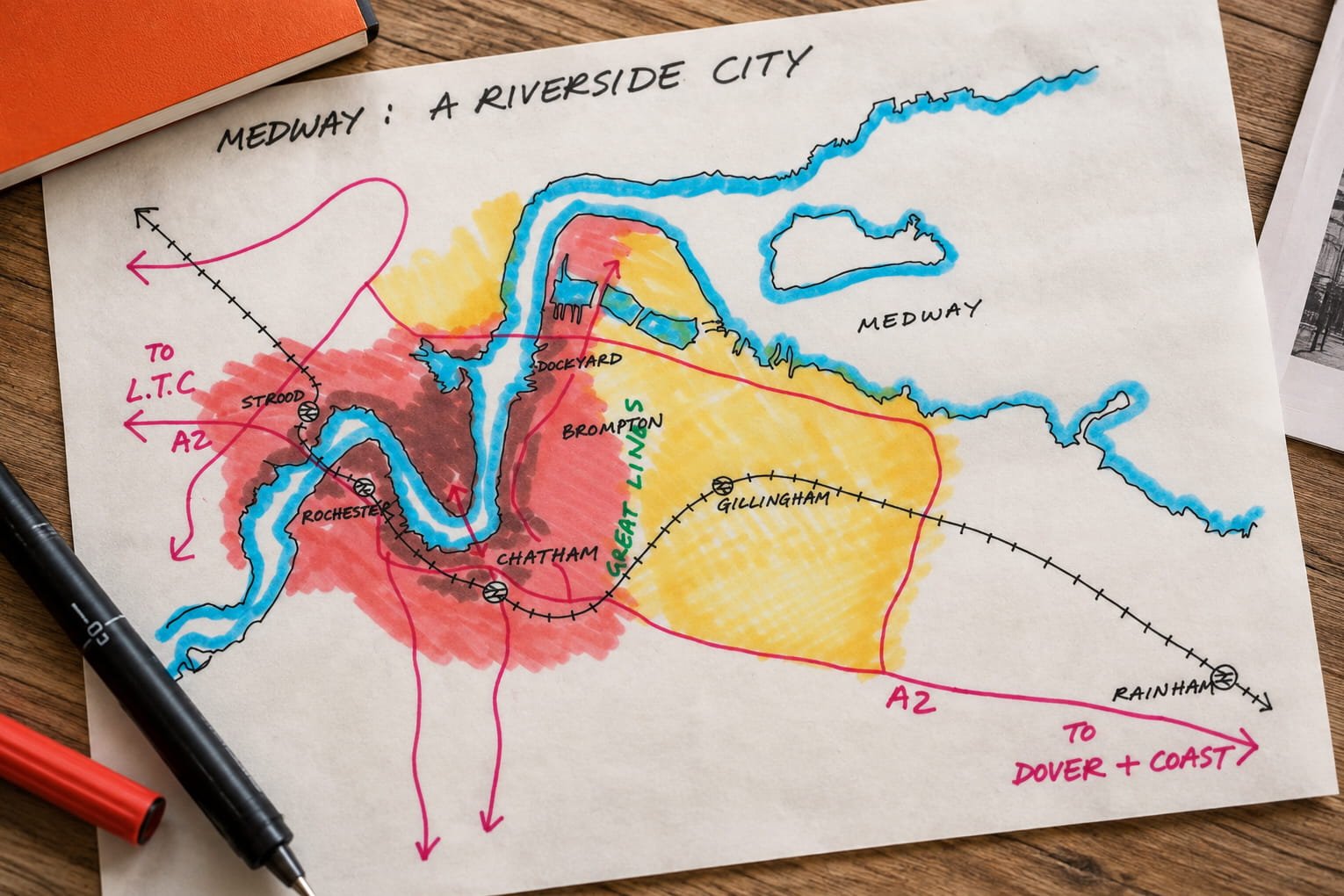
My work over the past 20 years has included getting to know the lie of the land in Chatham, Kent, by designing schemes for the Waterfront and the Town Centre, together with assisting on a very thorough Design Code testing process for the area. The “motivator” behind the more recent transformations is Medway Council’s in-house design adviser, Duncan Berntsen, aided by the excellent planning head, Dave Harris.
A Proper Big City for Kent
As a large local authority, Medway District Council embraces a number of densely populated historic towns. At least three of them, Strood, Rochester and Chatham, hug the banks of the twisting route of the River Medway. Chatham’s historic Dockyard is strategically placed just before the river widens out to eventually join the Thames Estuary.
With recent urban regeneration activity in Chatham and Rochester mostly near the water’s edge, we could consider the whole area as a “riverside city”. The three stations are well-served by fast trains to Central London in 30 to 35 minutes. Also, the proposed Lower Thames Crossing will be only a few miles away for drivers connecting from Kent’s A2 through to Essex and the Capital via a new tunnel beneath the Thames.
Urban Waterfronts Can Be Exciting
The impact of these three towns is figuratively “linear” and “looped” across from each other. Their housing (old and new), commercial buildings and naval warehouses become part of the riverside urban grain. Some key areas deserve a “fresh start”, like the ill-placed 1970s industrial sheds area on the Wainscott Peninsula, right opposite Chatham’s regenerated town centre facing the unfortunately-named Rats Bay.
Future thinking for the areas is currently driven by the energy and vision of Duncan Berntsen and Dave Harris. As my sketch map shows, both sides of the river, winding through this historic conurbation, are increasingly becoming attractive places to live and work, together with evolving cultural and higher education facilities. Urban living near three prominent stations can mean that residential properties without car ownership are acceptable and feasible in this context.
Current Regeneration Must Inter-Connect the Three Towns
LBY’s recent work on the adaptation of the monumental 12-storey Mountbatten House in Chatham town centre into new housing is a key part of the regeneration of North Kent into an urban hub.
The practice’s work with nearby masterplans and contributions to testing Medway’s recent Design Code have taken the new renaissance further forward, impressing the DLUHC government sponsors.
More recently, Duncan Berntsen’s creation of an “Urban Room”, based in a café near Chatham’s High Street, has enabled a range of welcome community discussions about the town’s future with Council officers, design and planning professionals, and developers.
City status could not be far away now!