
Biophilic Design in Secondary Schools
May Parkes-Young’s research asks what happens when nature shapes the design of a secondary school from the outset, rather than being added at the end.
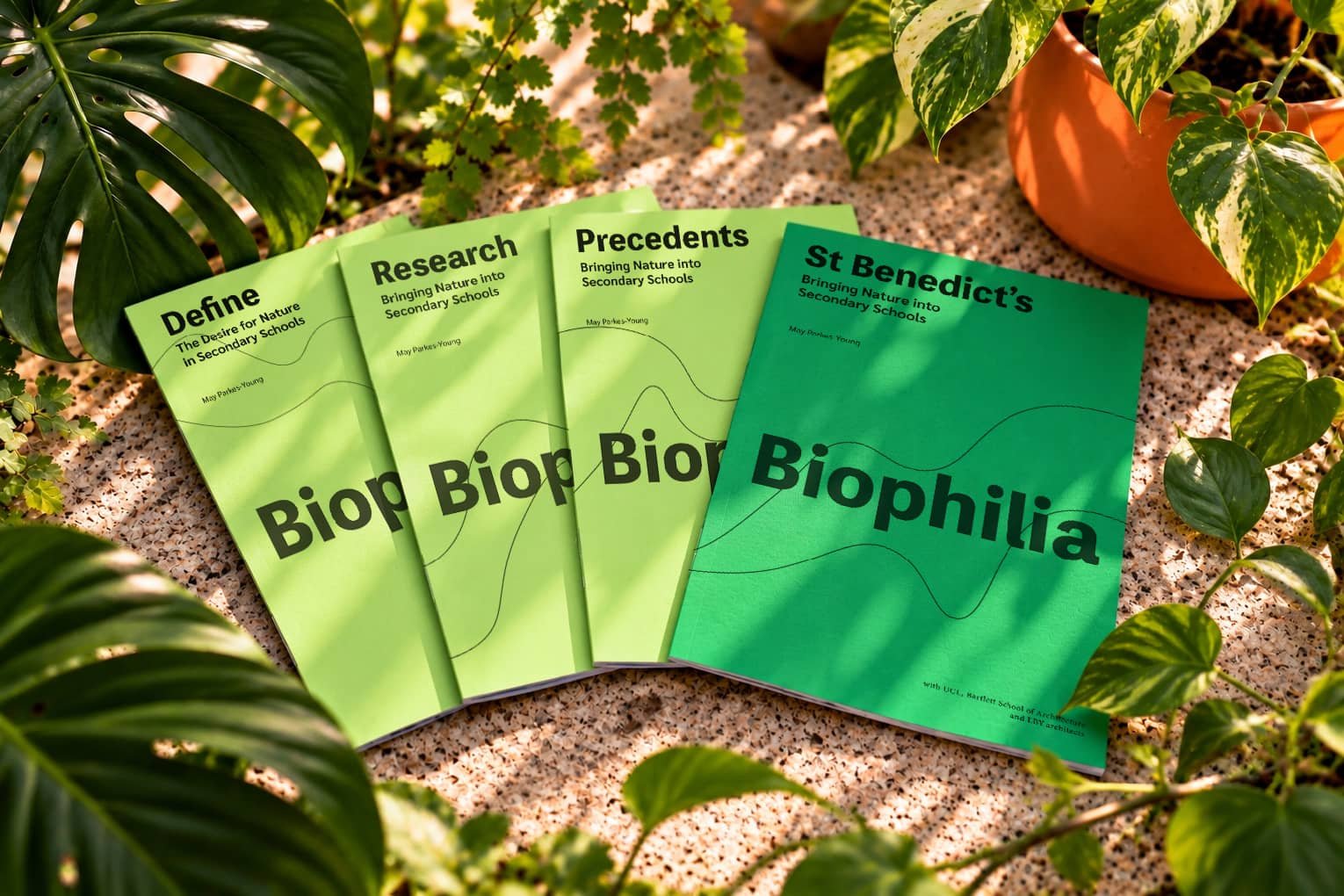
Humans have an innate desire to be within and surrounded by nature; it’s in our DNA. Biophilic design is the actualisation of this instinct, through integrating the natural world and the built environment.
It is often reduced to a fairly simple idea: bring more greenery into a building.
Plants have their place, of course. But if our relationship with nature can affect how we feel, concentrate and experience a space, the question for architects is much broader than where to put the planting.
What happens if nature begins to influence the design from the outset?
That question has been at the heart of a piece of research undertaken by LBY Architectural Assistant May Parkes-Young as part of her MSci Architecture programme at UCL.
The research developed alongside May’s work at LBY and, importantly, alongside a live education project.
A live project as the starting point
May joined LBY while we were working on proposals for St Benedict’s, a secondary school project where biophilic design was already part of the brief, set by the Department for Education rather than something we arrived at ourselves. That gave May's research an unusually direct connection to work already happening in the office.
"What interested me was the opportunity to connect May’s academic research directly with a live project, so the research could inform the design, and the realities of the project could inform the research."
Neil Young, Director, LBY Architects
For four days each week May was embedded within the practice, working as part of the LBY team. Her fifth day was devoted to her university research, with support from UCL and mentoring within LBY.
Rather than investigating biophilic design as an abstract academic subject, she could explore ideas with an immediate connection to the questions we were already considering in practice.
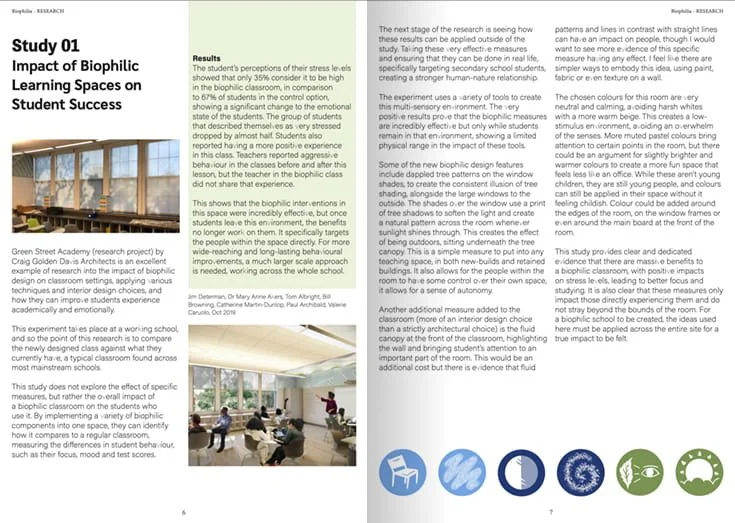
Why might a relationship with nature matter within a secondary school? What does existing research tell us about how young people respond to their surroundings? And, for an architect, how can that evidence actually influence design decisions rather than sit in a report?
The St Benedict’s project established the secondary school context for May’s research, but it also highlighted an interesting gap. Much of the existing discussion around children and nature focuses on younger pupils, while teenagers can be comparatively overlooked. Yet secondary school students have different needs and respond differently to their surroundings, meaning the biophilic approaches that work for younger children cannot simply be transferred wholesale into a secondary school environment.
More than adding plants
One of the clearest conclusions from the research is also one of the simplest. Biophilic design is about considerably more than greenery. As May puts it, “You can't really just plonk a green roof or a green wall on a building.”
It has to go beyond green-washing. Biophilic design must be considered from the very beginning of the design process. It acts as a central component around which site constraints, building regulations and local context orbit.
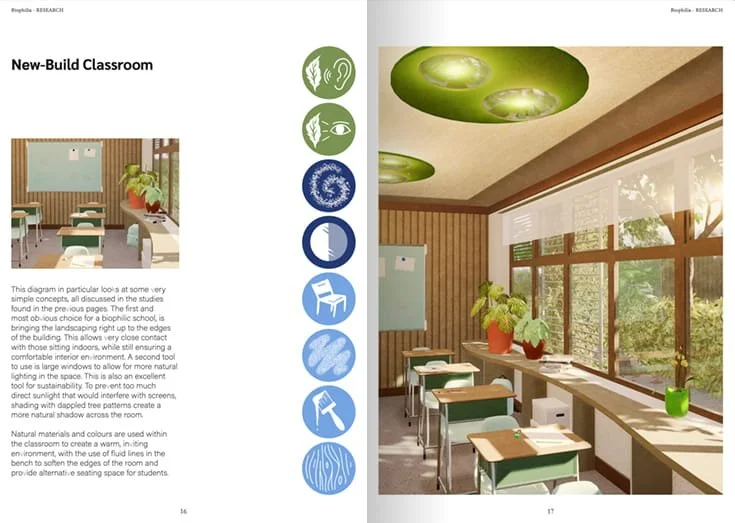
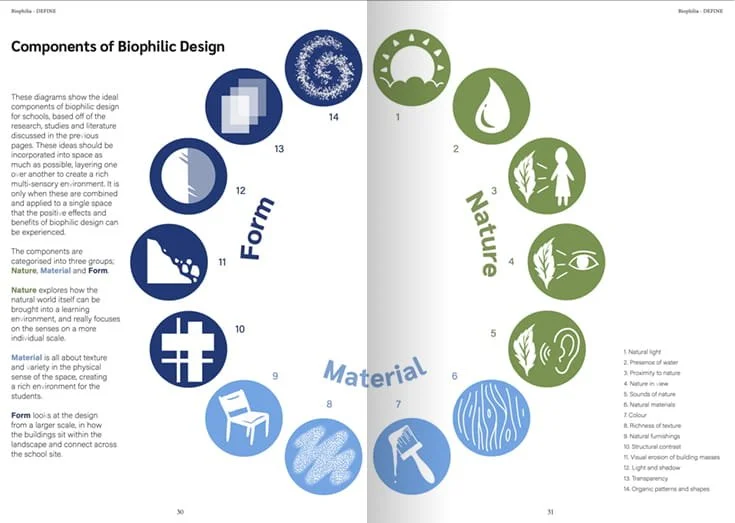
Our experience of nature can come through natural light, views, sound, materials, texture, colour, landscape, patterns and form. That means biophilic thinking can influence decisions about orientation and structure just as much as decisions about planting. It also means there isn't a single biophilic solution that transfers neatly from one school to another.
A space intended to encourage concentration may need something different from one intended to create calm. A classroom, a circulation space and an external learning area will each have their own requirements. The starting point has to be the experience you're trying to create, not the feature you already have in mind.
Or, in May’s words: “You almost need to start further away, and then zoom in and apply the context.”
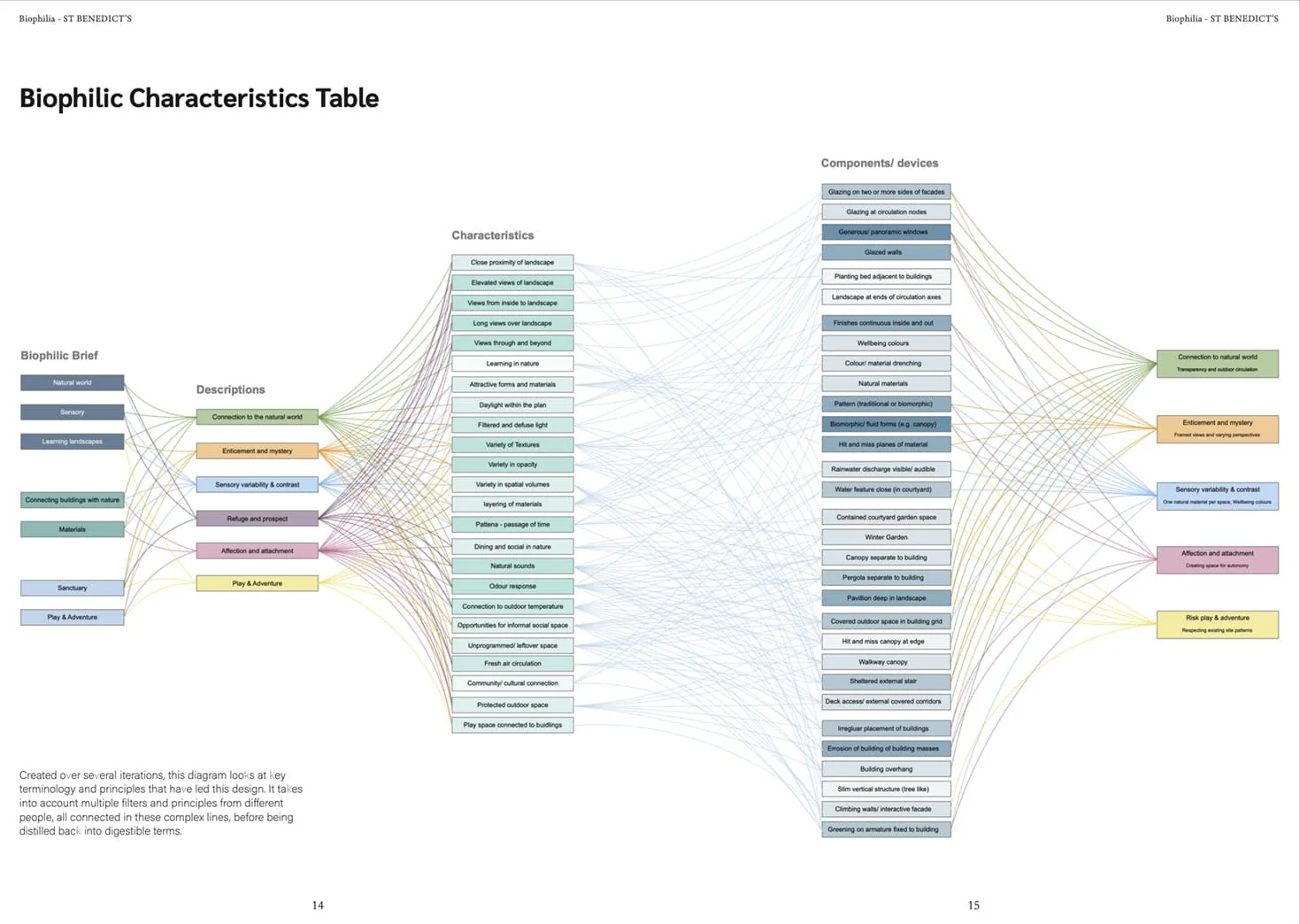
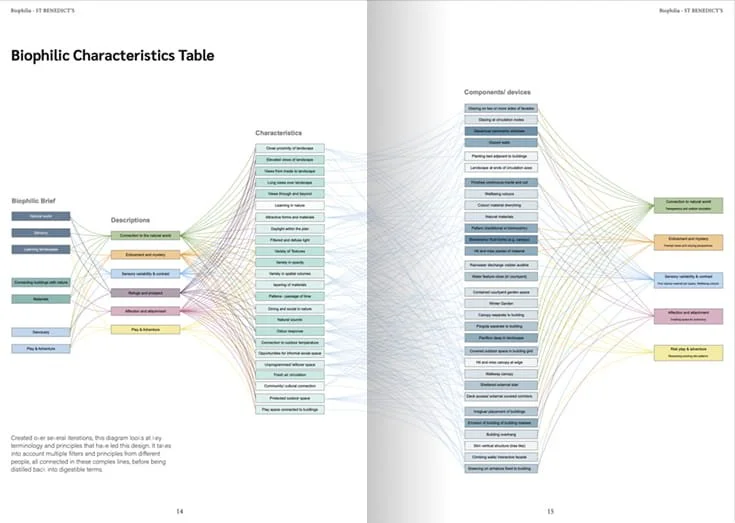
Biophilic characteristics diagram mapping connections between design principles, natural elements, spatial characteristics and architectural features at St Benedict’s School.
Turning research into a practical framework
A major part of May's work was concerned with making that transition from research into something that could actually inform design.
The resulting study brings together research around nature, material and form, and sets out how different biophilic principles relate to the outcomes they're aiming for and the design responses that might achieve them. The result is a framework that allows those connections to be explored, rather than treating individual features in isolation.
For us, this is where the work becomes genuinely useful in practice. Research earns its place on a project when it starts asking better questions of the design. If we want an environment to support concentration, wellbeing or a stronger connection with the outside world, what combination of decisions might actually contribute to that?
Rather than starting from a predetermined feature (we need a green wall here), the framework encourages the design team to start from the experience they want to create and work back towards an appropriate response.
Research within practice
Research has always had a close relationship with LBY’s work, particularly within education. Live projects raise questions. Research gives us a chance to look into them properly. The useful part is bringing that learning back into practice.
May’s MSci placement offered a particularly direct version of that: academic research happening alongside day-to-day architectural work, each able to inform the other. It also gave her the chance, relatively early in her career, to build a substantial piece of research directly connected to the work she was encountering in practice.
Supporting that wasn't separate from the work of the practice. It fitted naturally with our own interest in evidence, education and understanding how buildings actually perform for the people who use them.
What happens next
May’s completed research will form part of the first public exhibition of the MSci Architecture placement-year work at The Building Centre in London, running from 19 November to 4 December 2026, which LBY is pleased to be supporting.
Over the coming months, we'll also be sharing some of the individual ideas that came out of the research. What role does sound play in our connection with nature? What does the evidence actually tell us about young people and their environment? How does research get turned into a practical design tool? And what happens when those principles meet the realities of a live education project?
For us, those questions are ultimately what makes research worth doing. Not research for its own sake, but research that has the potential to change the way we design.
Written by May Parkes-Young & Neil Young.