
Drawing as a Way of Thinking
John Lyall reflects on why hand-drawing remains essential to his architectural expression.
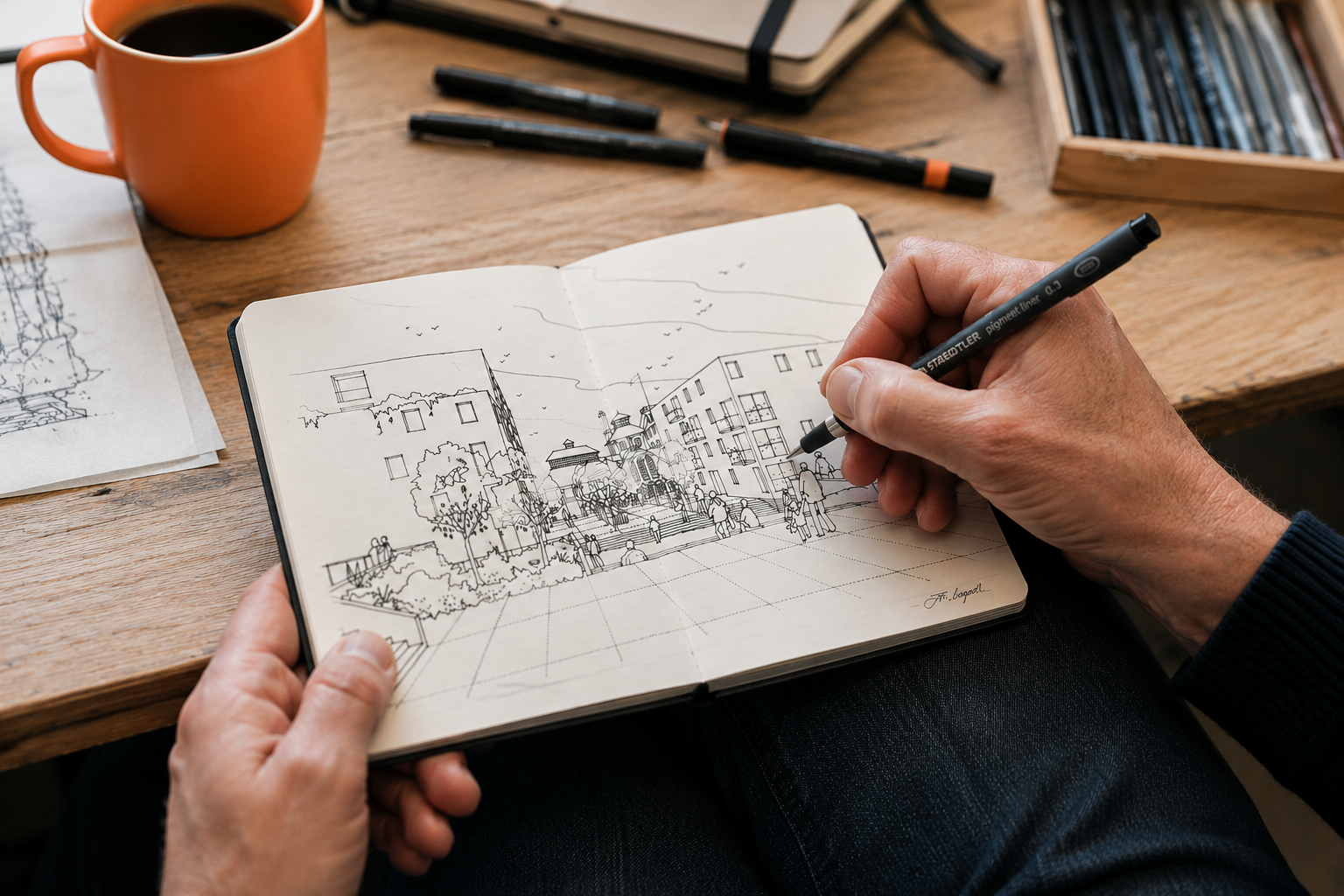
I have enjoyed drawing since I was a child, and for all my years as an architect, communicating a design concept by a 3D hand sketch has been a natural part of the creative process.
I still draw plans, sections and elevations by hand; I find the process quick, accurate and easy to edit. Even though I invested a great deal of money in installing the latest computers in our offices over the past 40 years, I never learned how to use CAD myself. I always preferred to draw by hand.
I believe there is an automatic, fast link between the eye, brain and the moving hand which can depict graphically in a way that clicking on a mouse does not. Also, the hand-drawn image embodies the personality and vision of the architect in a way that a computer image can never really achieve, no matter how slick the software.
That is my view, which I know some CAD users will take issue with.
CAD Has Its Limits and Can Look Sterile
A computer rendering seems configured to show too much — or everything — in its detailed brain and at the extremities of the image. The hand drawing has a different intent and focus; it can edit and draw attention to what the architect or artist would like you to see primarily, and what is most important about the design of the building.
The hand sketch is also unique because it has character, instilled with the vision of the artist who has taken the trouble to compose it and put pen to paper.
Hand Drawn for Character
I do use basic computerised “frame” or “block” images as starting guides, but in the sketch over-tracing I add only as much detail as I need to the building or interior. I can then populate the scene with my depiction of various people, old and young, with trees, furniture and cars, etc.
The line drawing works well in black and white alone, but a few touches of colour are often enough to give it a little more presence in a presentation.
Back of a Fag Packet
It is a classic trope for an architect to communicate ideas to a client by sketching on a napkin in a restaurant or on a pad in a meeting. It always impresses, and it is inevitably accompanied by stream-of-consciousness dialogue about the organic nature of the design process.
The late, great Ted Cullinan was a real master at this. He would tell a complete story with a felt-tip pen and an old-fashioned epidiascope.
In schools of architecture in the UK and abroad, I still expect all students to be able to competently hand draw. It’s an essential part of becoming an architect, in my view.
There was only one famous architect who couldn’t draw — my former boss Richard Rogers — but he compensated in other ways by being a brilliant communicator to his team and clients, who were able to deliver his vision.
Written by John Lyall.